


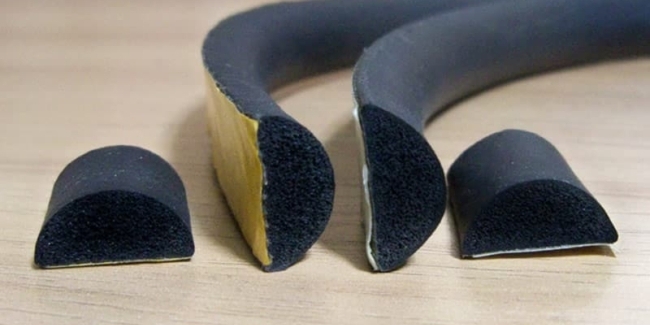
EPDM Sponge Seals
Advanced Seals & Gaskets Ltd produces some of the highest-quality seals in the UK, with EPDM sponge seals available as gaskets, washers, O-rings, cord and extrusions, all designed to prevent leaks or the ingress of air, fluids and gas.
All our EPDM sponge seals are made to order and are produced in accordance with the samples or drawings provided by customers to ensure the final product fits the application perfectly. We can supply EPDM sponge seals in a wide range of forms and quantities to meet your specific requirements.
As each form of EPDM sponge seal requires a different manufacturing process, ASG has invested heavily in various machinery, enabling us to offer seals in both high and low volumes.
To enquire, please use the form provided. You can specify your requirements in the enquiry box on the product page.
What are EPDM Sponge Seals?
EPDM is an abbreviation of Ethylene Propylene Diene Monomer, which is the chemical component used to manufacture this sponge. EPDM sponge is a strong, closed-cell synthetic material, making it ideal for internal and external sealing applications where minimal compression is required for effective performance.
EPDM sponge seals are devices or substrates used to join surfaces, acting as separators or barriers to prevent liquids, particles, or gases from escaping or penetrating the application. An EPDM sponge seal is a type of rubber seal designed for specific sealing applications. ‘Seal’ is a generic term for products often taking the form of cut gaskets, strips, washers, extruded or moulded profiles, edge trims and cord.
Most of the EPDM sponge seals produced by Advanced Seals and Gaskets can be supplied with a choice of self-adhesives, which assist with placement and holding the seal in position. EPDM sponge seals are also available in plain (uncoated) formats for applications where adhesive backing is not required. EPDM sponge seals are typically used where flexibility and cushioning are needed, such as in dust, debris, and draught exclusion. In contrast, other types of rubber seals offer greater stability and durability for industrial, construction, and marine environments.
Product Enquiry
For information on EPDM Sponge Seals please complete the following quick enquiry or call us on +44(0)1384 252555.
Product Specification & Key Characteristics
- Black and white options (medium-density only)
- 90 – 140kg/m3
- Flammability Tested: FMVSS 302
- Operating Temperature: -20°c to +85°c
- Thickness: 1mm - 50mm (without laminations)
- Environmental Resistances: Ozone, UV, weather, weathering
- Chemical Resistances: ketones, diluted acids and alkalis
- Excellent Resistance: EPDM sponge seals offer excellent resistance to extreme temperatures, weather, ozone, and chemicals.
EPDM sponge seals can be customised to achieve other properties, such as hardness and flexibility, to suit specific application requirements.
They are also suitable for use with a variety of surfaces, including metal, in construction and industrial applications.
Types of Sponge Rubber Profiles
Sponge rubber profiles are available in a wide range of types, each designed to deliver a reliable seal and meet the specific demands of different sealing applications. These profiles are manufactured from various materials, including EPDM (Ethylene Propylene Diene Monomer), Neoprene, and Silicone, allowing for a tailored solution based on the required resistance to UV, moisture, chemicals, and other environmental factors.
A key advantage of sponge rubber profiles is their closed-cell structure, which effectively blocks the passage of air, liquids, and gases between two surfaces. This cellular structure not only ensures an airtight and watertight seal but also provides a resilient material that maintains its shape and sealing properties even under repeated compression and exposure to vibration. As a result, sponge rubber profiles are widely used in applications where durability and long-term performance are crucial.
For ease of installation, sponge rubber profiles can be supplied with or without adhesive backing. The self-adhesive option allows quick, secure placement, ensuring the seal remains firmly in place and preventing the ingress of dust, moisture, and other contaminants. This makes them ideal for use around doors, windows, and other areas where a tight, reliable seal is essential.
Beyond their sealing capabilities, sponge rubber profiles offer excellent cushioning and vibration damping, making them a preferred choice for noise reduction and protection against mechanical shock. This combination of properties is especially valuable in industries such as construction, automotive, and manufacturing, where both sealing and cushioning are required to protect components and enhance comfort.
The choice of material for sponge rubber profiles depends on the specific application. EPDM sponge is highly resistant to UV radiation and weathering, making it suitable for outdoor and exposed environments. Neoprene sponge excels at resisting oils and chemicals, making it a strong candidate for industrial and automotive applications where contact with such substances is likely. Silicone sponge, meanwhile, offers outstanding temperature resistance and flexibility, making it suitable for high-temperature or specialised environments.
At Advanced Seals & Gaskets Ltd, our sales team is available to provide expert guidance on selecting the most suitable sponge rubber profile for your needs. We offer a comprehensive range of materials, thicknesses, and profiles, ensuring you receive a sealing product that delivers the right combination of properties for your application—whether you require resistance to weathering, chemicals, pressure, or vibration.
In summary, sponge rubber profiles are a versatile and dependable solution for a wide variety of sealing applications. Their unique blend of sealing, cushioning, and vibration-damping properties, combined with the availability of different materials and adhesive options, makes them an essential component in achieving reliable, long-lasting seals across many industries.
Why use EPDM Sponge Seals?
EPDM sponge seals are designed to prevent the escape or ingress of dust, air, liquids or gases when compressed between irregular surfaces - very much used in the same way as a gasket. Seals can also be used as an aid for shock, noise and vibration dampening in a range of industries. In addition, EPDM sponge is highly effective at reducing vibrations in industrial and building applications.
Our EPDM sponge seals can commonly be found used in valves, pumps, engines, machinery, electrical appliances - in fact, seals are used in applications where there is a risk of leakage, where harmful or toxic liquids & gases are present, where components need to be kept separate or for protection on moving parts. For a seal to work effectively, it must compress and fill the entire space, creating pressure and airtight protection. EPDM sponge also provides excellent insulation and helps prevent heat transfer in various applications.
As EPDM sponge is a closed-cell material, even when not compressed, its nitrogen-filled cells prevent the passage of air, liquids, and gases. The release of nitrogen gas gives the material its firm compression set and recovery characteristics.
EPDM sponge seals are a popular product across a variety of applications for a number of reasons and can be found in the construction industry, automotive interiors, electronics, lighting systems, ventilation, glazing, and door seals.
The Benefits of Using EPDM Sponge Seals
- Noise, vibration, shock and abrasion reduction
- Flexible with good compression recovery
- Cost-effective and readily available
- Naturally compressible to create the perfect seal to control air and water leaks
- Closed-cell structure prevents bacteria and mould from building up
- Excellent properties make it popular for use in a range of industries and applications
- Easy to convert into a range of products, including gaskets, and will hold most adhesives well
The Advantages of Using EPDM Sponge Seals
EPDM sponge seals are produced from a strong, closed-cell synthetic material, making them ideal for internal and external sealing applications where minimal compression is required for effective operation. It has an excellent lifespan, even when used outdoors, and is free of dust and fibres.
EPDM sponge seals can be manufactured in a vast range of sizes and thicknesses, with a choice of foils and self-adhesives applied to one or both faces. For very thick seals or combinations of required properties, the EPDM sponge can be laminated in layers or bonded to other materials for use in more specialist applications.
EPDM sponge is a popular material that is air- and water-tight, ages well without becoming brittle, offers good UV resistance, and withstands a wide range of temperatures, from -20°C to 85°C.
It's an excellent electrical insulation material, with good resistance to ketones, ordinary diluted acids and alkalis, Ozone, UV, and weathering, as well as general abrasion resistance. EPDM foam is also flammability tested to meet FMVSS302 and UL94 HBF standards.
Grades of EPDM Sponge Seals Available
ASGstocksk a variety of other grades and densities of EPDM sponge, which can be used to manufacture gaskets, each suited to individual applications. These include firm grade, high temperature and semi-open cell varieties:
High Temperature EPDM Foam is closed-cell and highly flexible, even at low temperatures, with an impressive temperature range of -50°c to +128°c. High-Temperature EPDM foam has many excellent mechanical characteristics, including thermal and insulation properties, making this material ideal for many industries and applications, including HVAC, Refrigeration, Pipeline, Automotive, White goods, and Building & construction.
Semi-open-cell EPDM combines the flexibility of an open-cell material with the excellent sealing capabilities of a closed-cell material once compressed. Semi-open-cell EPDM pads allow air, dust, and moisture to ingress until compressed to 80% of their thickness; once compressed, the product becomes water- and airtight and behaves as a closed-cell product.
Firm Grade EPDM Foam is a more resilient material that will not compress as much as the standard grades under load. Also, this material benefits from increased tear strength and suits some of the more demanding applications, such as Automotive, White Goods, Marine, Defence, Building and Construction, etc
Please contact us using the form below or by calling us on +44(0)1384 252555.