


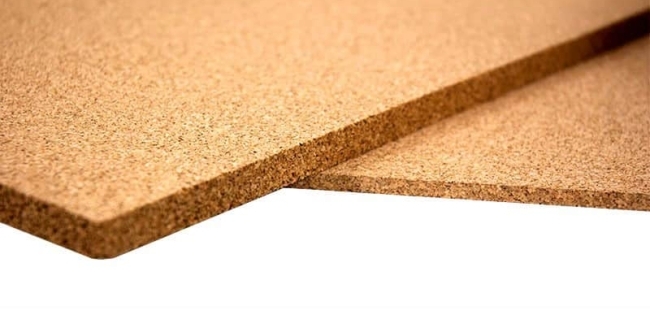
Natural Cork Sheets
ASG stocks and supplies many materials, including natural cork, which can be converted into a range of products, such as gaskets, pads, and sheets, with plain or self-adhesive finishes. Corkboard sheets are versatile products commonly used to make personalised pin boards, provide thermal and acoustic insulation, and display educational materials and announcements in offices and schools.
Natural cork sheets are available in 1m x 1m or 2m x 1m sizes and in a range of thicknesses; however, using our expertise, specialised splitting machinery, and in-house laminating service, we can offer other thicknesses or combinations of laminated materials to create composite sheets. Cork is also available in roll form, valued for its high density, elasticity, moisture resistance, and sustainability, making it ideal for insulation and protective applications.
Cork sheets can be purchased for applications where larger surfaces need to be covered or where larger products need to be cut. Cork sheet is a versatile material used in residential and commercial interiors for insulation, soundproofing, and decorative accents.
The manufacturing and conversion of cork into sheets and other products involve careful processing that enhances the appearance, durability, and suitability of the resulting sheets for various applications.
What are Natural Cork Sheets?
Natural Cork consists of grains of cork compressed together with a liquid binder known as ‘agglomeration’. Natural cork is environmentally friendly and relatively cheap compared to sponge and rubber. It can be used to produce basic items such as coasters, mousepads and notice boards, as well as parts for sealing, thermal, acoustic and thermal insulation applications. The production of cork sheets generates very little waste, making them a sustainable choice. Cork is generally manufactured in continuous rolls or sheets, depending on thickness, thereby allowing us to offer customers a range of sheet sizes. Choosing a suitable thickness depends on the intended application. Thicker cork sheets are more effective for insulation and sound absorption, while thinner sheets are better suited for crafts and decorative uses.
Cork sheets are versatile and can serve a variety of purposes in different settings, making them appropriate for any environment or use.
Product Enquiry
For information on Natural Cork Sheets please complete the following quick enquiry or call us on +44(0)1384 252555.
Product Specification & Key Characteristics
Natural cork sheets, as the name suggests, are natural in colour because no other materials are added, are lightweight, and are somewhat flexible. This material is impermeable to liquids and gases, meaning it is an excellent sealing material and therefore resistant to moisture damage and decay. Natural cork sheets are also highly durable, making them ideal for demanding applications.
Natural cork is an excellent material for thermal, acoustic, and vibration control applications, such as wall/floor insulation or a base material under heavy machinery or compressors, providing protection against varying temperatures and chemical or odour contamination. Cork sheets are often used as a surface material for finishes and decorative coverings, and are suitable for both residential and industrial interior styles.
Cork sheets can be supplied cut into bespoke lengths and widths, laminated with a choice of foils and adhesives and even laminated to other materials, creating composite sheets.
Why use Natural Cork Sheets?
Natural cork sheets are highly versatile and are often taken, as they give customers and end-users the flexibility to cut their own sheets, strips, pads, and gaskets out as and when required. For example, corkboard sheets can be used to create personalised pin boards or bulletin boards in offices and schools.
Natural Cork sheets and products produced from this material are utilised in many industries. They are popular thanks to their excellent properties, including being lightweight, able to withstand high pressure without degrading, and highly tear-resistant. The thickness of cork sheets also affects their ability to securely hold pins for displaying notices or photos.
This material is a cheaper alternative to some sponge and rubber materials, with high mechanical strength, a working temperature range of -80°C to 140°C, and excellent water- and gas-sealing performance, even when used outdoors.
Benefits of Using Natural Cork Sheets
- Sound Suppression
- Thermal Properties
- Bonded with other materials based on the application
- Anti-Vibration
- Resistance to weathering
- Easy to cut/convert
- Non-toxic and safe to work with
- Resistant to mould growth
- Aesthetically more appealing than some rubber alternatives
Corkboard sheets are also popular for displaying photos and organising reminders in both home and office settings.
Different Grades of Cork Available
Along with natural cork, other grades of cork sheets are available, each with unique characteristics depending on the material with which it is blended. Grades of cork include Neoprene Bonded, Nitrile Bonded and Resin Bonded.
Neoprene-bonded cork is suited to sealing at higher temperatures and is resistant to weathering and oil. Neoprene Bonded cork is suited to oil, engineering, electrical, anti-vibration and soundproofing applications.
Resin-bonded cork – a lightweight, flexible cork, produced using cork granules bound together using a synthetic resin. This grade of cork is resistant to specific acids. It is often used in water-retaining applications—nitrile-bonded cork, manufactured from a combination of cork and nitrile rubber granules, giving a speckled appearance. Gaskets made from this material can be used where oil and fuel resistance is required, or where high-temperature resistance is required. Industries include automotive and general engineering.
Please contact us using the form below or by calling us on +44(0)1384 252555.